
Recovery & Aftercare
Why We Didn’t Send You Home With Steroids
The short answer: you were already dosed. The longer answer is more interesting.
If your wisdom teeth came out at our office and you went home without a prescription for steroids, it’s fair to wonder whether something slipped through the cracks. It didn’t. The single most important anti-inflammatory dose of your entire recovery was already given — quietly, during your procedure, before you felt a thing.
Here’s the 60-second version, and then the full story underneath.
#Facts with Dr. Escalante — the 60-second version.
The steroid you already got
During your surgery, we typically give a single dose of dexamethasone — a long-acting steroid (often around 8 mg) — right at the time of your procedure. Swelling and jaw stiffness after oral surgery aren’t random. They’re inflammation, and inflammation runs on a predictable chain of chemical signals. Dexamethasone steps in near the very top of that chain and turns the volume down before it ever gets loud.
That timing is the whole trick. A steroid given before inflammation builds is playing offense. A steroid given after it has already peaked is playing catch-up — and catch-up doesn’t work nearly as well.
Why a single dose is enough
Post-op swelling keeps a schedule. It builds over the first day, peaks somewhere around 48 hours, and is largely fading by day three. Jaw stiffness trails it by a day or so.
Dexamethasone is built for exactly that window. One dose keeps working well beyond the few hours it actually spends in your bloodstream — it works by dialing down the genes that drive inflammation, and that effect lingers for a day or two after the dose is given. A single, well-timed dose covers the entire peak. There’s nothing to keep topping up, because the job is already done.
Then why not send home a steroid pack, just in case?
It’s a reasonable instinct — more medicine, more days, more relief. So researchers actually put it to the test, and two findings settled it.
First: when you hold the total amount of steroid the same, giving it all up front beats splitting it across days. Front-loading wins.
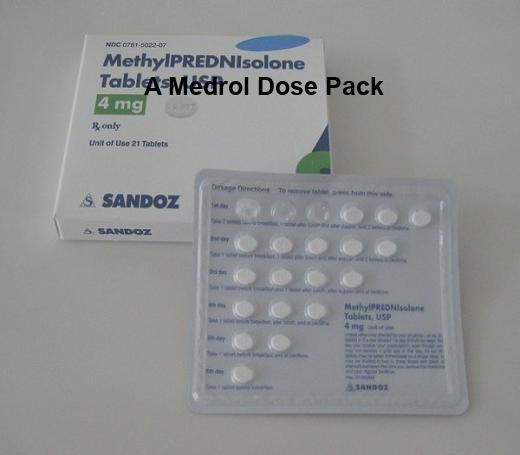
Second: the popular six-day steroid “dose packs” spend their back half arriving after the swelling has already come and gone. By day five you’d be taking pills for a problem that resolved on day three — and the first couple of days of that pack mostly duplicate the dose we already gave you on the table.
Steroids work best getting ahead of inflammation — not chasing it.
And steroids aren’t free
Even short courses of oral steroids aren’t nothing. A growing body of research links brief steroid bursts to a small but real increase in certain risks — and that six-day pack happens to be one of the most commonly prescribed steroid courses in the country. The point isn’t that it’s dangerous. It’s that, for a routine extraction, it’s usually unnecessary — and “unnecessary, with any downside at all” isn’t a trade we make without a reason. (That calculation shifts further if you’re also taking an anti-inflammatory like ibuprofen, or if you manage diabetes.)
When we do send you home with steroids
Individual cases are exactly that — individual. Some genuinely call for more: deeply impacted teeth that require removing more bone, longer or multi-quadrant surgery, a personal history of dramatic swelling, or corrective jaw surgery. In those situations, extending steroids is the right call, and we make it deliberately.
So if your surgeon — here at Dry Creek, or anywhere else — did send you home with a steroid course, that wasn’t a reflex or an afterthought. It was a decision made for your case. Follow it exactly as written.
The bottom line
Your recovery plan is built around timing, not quantity. The most effective anti-inflammatory moment of your whole recovery already happened — before you were even awake. From there, the ice, the medications on your instruction sheet, rest, and a little patience carry you the rest of the way.
Still swollen, sore, or just not sure whether what you’re feeling is normal? That’s not a bother — that’s what we’re here for. Give us a call.
Dry Creek Oral Surgery
Dr. Daniel Escalante & Dr. Jeremy Jannuzzi · Denver Tech Center
Oral & Maxillofacial Surgery
This article is general education about how our team approaches recovery — not personal medical advice. The specific instructions your surgeon gave you for your situation always come first. If you’re experiencing severe pain, spreading swelling, fever, difficulty breathing or swallowing, or bleeding that won’t stop, contact our office or seek care right away.
Leave a Reply